I came across this great article in Mortgage Logic News subscription. Long story short, no need to take a variable rate today at a heavy discount based on fear that the discount will decrease in the short term. People fearing this are essentially basing it on the most recent historic rate-tightening cycle in 2022, but ignore the facts during the 3 previous major tightening cycles. Today’s evidence does not steer us to the same logic used in 2022. Here is the full article:
______________________________________________________________________________________________________________
Some Rate Signals Actually Predict Your Variable Discount. This Isn’t One of Them
The Globe ran a story this week quoting a frequently cited broker who said:
“Typically what we’ve seen in the past is the [variable-rate] discount declining when rates are increasing.”
“Typically” is not the word we’d use, because the actual data doesn’t jibe with it.
Before anyone starts telling clients that rising rates will destroy floating-rate discounts, let’s look at what the numbers actually say.
The facts:
- Over the last two decades, we’ve lived through four full rate-hike cycles, our testing ground for the theory that discounts shrink when the overnight rate climbs. (Note: July 2004 is as far back as MLN’s variable discount data goes. It’s a 268-month sample, not ideal, but instructive nonetheless.)
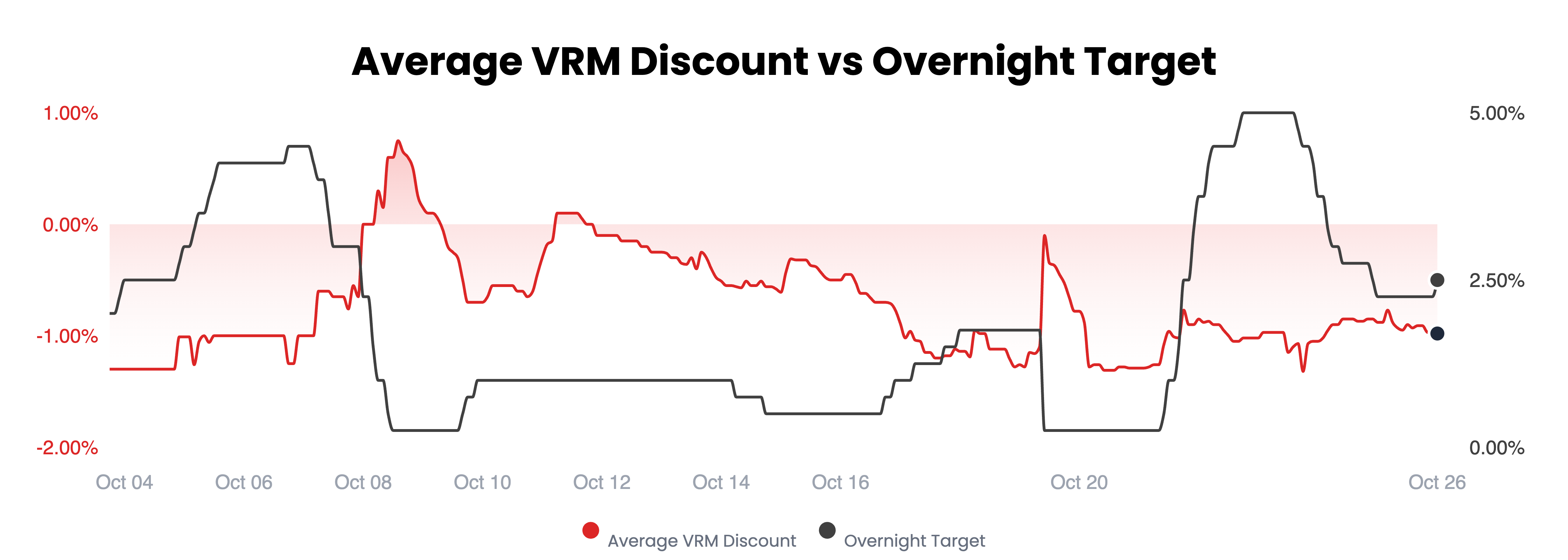
- With a -0.46 correlation, there is a modest inverse relationship between variable-rate mortgage (VRM) discounts and the overnight rate. (Full stat analysis here.)
- Since 2004, VRM discounts narrow sharply when the BoC cuts in a crisis and either shrink or improve when the BoC hikes, depending on the macro drivers at the time.
- Looking at the scoreboard across the last four tightening cycles (measured from the month before the first hike to the month of the final hike):
- 2004 cycle: Discounts shrank 5 bps (30 bps at the peak)
- 2010 cycle: Discounts improved 40 bps (40 bps at the peak)
- 2017 cycle: Discounts improved 44 bps (50 bps at the peak)
- 2022 cycle: Discounts shrank 24 bps (49 bps at the peak)
- That’s a 2-2 tie. In half the cycles, discounts actually got better while the Bank of Canada (BoC) was hiking.
- If you pool all four tightening cycles together, the overnight rate climbed a combined 925 bps while the average discount actually grew by 55 bps. That works out to about 6 bps per percentage point of tightening—which, in statistical terms, is next to nothing.
- Where the real carnage happens is on the way down, and mostly when the financial system is on fire and risk premiums explode. Two examples: discounts got demolished—by as much as 175 bps in 2008-09 and 100 bps in March 2020. Compare that to the polite, orderly easing cycle of 2015, where discounts barely moved.
So, what happened in 2022?
The Globe’s story pointed to the most recent hiking cycle (2022) as an example of what might happen next. What that take misses is why discounts deteriorated in 2022.
Back then, lender funding costs (proxied by the late, great three-month bankers’ acceptances) were sprinting ahead of the prime rate.
At the time, forward-looking bond traders were pricing in aggressive BoC hikes well before Tiff Macklem actually pulled the trigger. That lag put lenders’ profit margins in a vise, forcing them to trim discounts just to defend their spreads.
Today, there’s no evidence of this, given:
- The spread between prime and the three-month T-bill (our new proxy since BAs went to the great money market in the sky in 2024) is holding remarkably steady as this hiking cycle gets underway.
- Just as importantly, despite credit spreads drifting modestly wider, they’re not blowing out by any means.
So lenders have little excuse to slap panic premiums onto their rates.
Why this matters
Saying “discounts worsen when the BoC tightens” isn’t a market rule. It is (and how do we put this politely?) a lazy, recency-biased market narrative.
It’s particularly untrue when prime and short-term rates move together in an orderly fashion.
And 2026 is not 2022. Nobody is pencilling in a manic 475-bp hiking spree this time around—least of all the bond market and the lenders pricing mortgages.
We can conclude with two tips:
For advisors: As this is being written, there’s little sign (yet) that clients must rush to lock down a good variable-rate discount before it’s gone. Whatever the Bank of Canada does next, history says VRM discounts are far more sensitive to how short-term rates move than to whether they move.
The signal to watch is the 3-month T-bill—or Term CORRA—relative to prime. If money markets start pricing hikes well ahead of the Bank—as in early 2022, when BA yields ran ~100 bps ahead of prime—that’s when lender margins get squeezed and discounts come under pressure. That is a cue to lock in discounts before they evaporate. Until that alarm bell rings, there’s no historical basis for urgency.
For borrowers: The choice between fixed and variable should rest mainly on the risk/reward and your outlook, financials, qualifications and psychology—not FOMO over a discount that might barely move.